
Susan Brewer: The Woman Behind One of Hollywood’s Most Famous Names
Quick Bio
| Detail | Information |
| Full Name | Susan Jane Brewer (later Susan Parsons Brewer) |
| Born | Exact date not publicly documented; grew up in Los Angeles, California |
| Nationality | American |
| What She Does | Former actress, artist, and casting professional |
| Biggest Accomplishments | Mother of actress Bridget Fonda; first wife of counterculture film icon Peter Fonda, married during his formative Hollywood years; acting credits include Lovely But Deadly (1981), Time Walker (1982), and Vision Quest (1985); worked in film extras casting under the name Susan Parsons Brewer |
| Other Key Facts | Her stepfather was Noah Dietrich, the man who served as Howard Hughes’s chief lieutenant and closest business confidant for decades — a connection that placed her family at the very nerve centre of Hollywood power; her daughter Bridget Fonda’s godfather is actor Larry Hagman; she raised Bridget and Justin largely away from the spotlight after her marriage to Peter Fonda ended in 1974 |
A Story Told Mostly Through Other People’s Biographies
Here’s the honest thing about Susan Brewer’s life: most of what gets written about her appears in someone else’s story. In Peter Fonda’s story. In Bridget Fonda’s story. In the sprawling, complicated, often heartbreaking narrative of the Fonda family dynasty that stretches from Henry through Jane through Peter and on down.
She’s always there at the edges. The first wife. The mother. The woman who was present during some of the most turbulent and creatively electric years of a man who would go on to make one of the defining films of the American 1960s. And then she’s gone from the public record almost entirely, stepping back into private life with a composure that deserves more attention than it gets.
What’s interesting about Susan isn’t just who she was connected to. It’s the particular kind of person you have to be to build a life right at the intersection of so many enormous personalities — Howard Hughes’s inner circle, the Fonda acting dynasty, Bridget Fonda’s ascent — and choose, at every available opportunity, to remain your own person rather than a satellite of someone else’s fame.
Growing Up in Howard Hughes’ Shadow
The most immediately startling thing about Susan Brewer’s background is the Howard Hughes connection. Her stepfather was Noah Dietrich — the man who served as Hughes’s right-hand for over three decades, managing his aviation empire, his film productions, his business dealings, and the vast complicated machinery of one of the most eccentric fortunes in American history.
Noah Dietrich wasn’t a minor figure in Hughes’s world. He was the central operational mind behind Hughes’s entire enterprise. For most of the years when Hughes was building his legend — the aviation records, the film Hell’s Angels, the acquisition of RKO Pictures, the TWA empire — Dietrich was the person making the actual decisions, handling the actual money, navigating the actual relationships. Hughes had the vision and the publicity. Dietrich made things function.
Susan grew up with that as her household reality. Not as a distant impressive fact about a famous person, but as ordinary domestic life. What it does to a child’s sense of scale — growing up in proximity to that kind of institutional power — is hard to fully articulate.It usually results in one of two outcomes. Either an inflated sense of entitlement, or a very clear-eyed practical understanding that fame and power are simply occupations, not personalities. Susan appears to have landed on the latter.
Her parents were Chauncey Marble Brewer and Mary Alice Sweet. The Brewer family had its own foundation in Los Angeles life, and her mother’s marriage to Dietrich wove Susan into Hollywood’s infrastructure in a way that predated any connection she would later form through her own choices.

The Young Woman Who Caught Peter Fonda’s Attention
Peter Fonda by 1961 was at the very beginning of everything. His father Henry was a living American cinema institution. His older sister Jane was about to become a star in her own right. Peter himself had just made his Broadway debut in Blood, Sweat and Stanley Poole and was heading toward Hollywood for his first film roles.
He was also carrying enormous personal weight. His mother, Frances Ford Seymour, had taken her own life when Peter was ten years old — a loss so traumatic and so poorly handled by the adults around him that it shaped the rest of his life in ways he was still processing decades later when he eventually wrote his autobiography. He had accidentally shot himself as a young boy. His relationship with Henry Fonda was affectionate but emotionally restrained in the way Henry Fonda’s relationships tended to be. Peter was, in short, a young man with profound need for stability trying to build a career inside one of the most unstable industries on earth.
Susan Brewer was the woman he chose to anchor himself to. They married on October 8, 1961, in Los Angeles. She was from the world. She understood the world. She wasn’t going to be dazzled by what he was part of, because she had grown up adjacent to something even larger.
Building a Family During Hollywood’s Wildest Years
The 1960s were not a tranquil decade to be married to Peter Fonda. The counterculture was building toward something enormous. Peter’s film career lurched between conventional studio projects and increasingly provocative independent ones. Roger Corman’s biker pictures. The Trip, Dennis Hopper’s direction, the building momentum toward what would eventually become Easy Rider.
Susan was there through all of it. Not on screen — that came later for her — but as the person holding the domestic centre of a marriage to someone who was simultaneously processing childhood trauma, experimenting with the drug culture of the era, and trying to figure out what kind of actor and filmmaker he wanted to be.
Their daughter Bridget was born on January 27, 1964. Larry Hagman — the actor who would eventually become internationally famous as J.R. Ewing on Dallas — was chosen as her godfather, which tells you something about the social world Peter and Susan were moving through during those years. Their son Justin followed, and the family settled into Los Angeles life with all the particular pressures that came with a Fonda household.
Peter described himself as an artist in the description his encyclopedia biography used for Susan too — “married Susan Jane Brewer, an artist” — which suggests her creative life was already developing independently of whatever role she played in supporting his. She painted. She made things. She was her own person in ways that the historical record around her tends to undercount.
Easy Rider, the Late 1960s, and the Beginning of the End
Easy Rider arrived in 1969 and changed everything about Peter Fonda’s career and cultural status. The film he had conceived, produced, and starred in became one of the defining documents of its era — a film about freedom, loss, and the death of the American dream told through two men on motorcycles crossing the country. It was screened at Venice. It launched a genre. It made Peter Fonda genuinely, internationally famous in a way that his earlier work had gestured toward but never quite delivered.
Susan was part of the story of that film, though not onscreen. She was part of the life that made it possible and the life that had to absorb the consequences of its success. Fame at that particular cultural moment, with that particular kind of film, brought a very specific kind of chaos with it.
The marriage was severely strained by the early 1970s. Peter’s restlessness was pulling him outward — physically and emotionally. He left Los Angeles to live in Montana in 1969. The marriage, which had survived nearly a decade of extraordinary turbulence, did not survive the specific pressures of that period. The divorce was finalised in April 1974, after thirteen years of marriage.
Susan was left with ten-year-old Bridget and Justin, as well as the unique task of raising two children from a well-known family without their father’s daily presence. without much interest in performing the drama of any of that for public consumption.
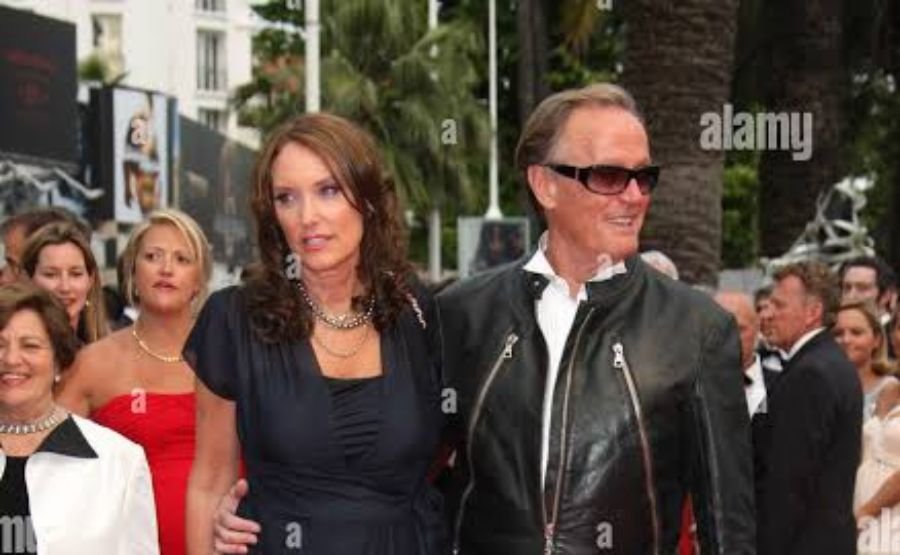
The Career She Developed on Her Own Schedule
After the divorce, Susan moved in a direction that was genuinely her own. She pursued acting — not as a strategic play off her ex-husband’s fame, but as a creative practice in its own right. Her credits are modest by the standards people use when they’re calculating celebrity. Lovely But Deadly in 1981. Time Walker in 1982. Vision Quest in 1985, the Matthew Modine film about a high school wrestler that has since become something of a cult favourite from that era.
These weren’t star vehicles. They were the work of someone who showed up, did the job, and moved on. She also worked in film extras casting, credited on several productions under the name Susan Parsons Brewer — suggesting she had taken another name at some point, likely through a subsequent marriage or personal choice, and that she understood the industry well enough to contribute to it from multiple angles.
The artist descriptor that ran through the early biographical sources is consistent with this picture of someone whose relationship to creative work was genuine rather than strategic. She painted. She worked. She built a life.
Raising Bridget and Justin
The most consequential thing Susan Brewer did, in terms of the shape of the larger story, was raise Bridget Fonda in a way that allowed her to eventually become one of the most genuinely talented actresses of the 1990s without the obvious damage that Hollywood upbringings frequently produce.
Even though Bridget was born with the Fonda name, the Fonda look, and access to a network that most young actresses spend their entire careers attempting to reach, she still had to earn her career. Single White Female, Jackie Brown, Point of No Return, Lake Placid. She built something real. And then, after a serious car accident in 2003 and her marriage to composer Danny Elfman, she stepped away from all of it and has lived in genuine privacy ever since.
Justin Fonda became a cameraman — someone who moved behind the lens rather than in front of it, contributing to the industry without performing for it. Both children, in their different ways, seem to have absorbed something about the relationship between the work and the spotlight that their mother modelled for them across her own quieter choices.
The Money: What’s Known and What Isn’t
Susan Brewer’s personal net worth has never been publicly documented in any credible source. She has no business profile, no public financial disclosures, no celebrity wealth estimates attached to her name in any reliable way.
What the context suggests: she received whatever settlement came from the divorce from Peter Fonda, whose estate at his 2019 death was estimated at approximately $40 million. She worked as an actress and in casting through the 1980s. The world of her stepfather, Noah Dietrich, was one of significant institutional wealth, and it is likely that her family history served as a foundation.
The picture that emerges is of someone who built a comfortable, sustainable private life without any particular display of wealth in either direction. Not ostentatiously rich. Not struggling. Simply living.
Where She Is Today
Susan Brewer is in her mid-to-late sixties or early seventies — the exact birth year not being something the public record has definitively established. She has outlived Peter Fonda, who died of respiratory failure from lung cancer on August 16, 2019, at seventy-nine.
Her daughter Bridget lives privately in Los Angeles with Danny Elfman and their child. Justin continues his work. The Fonda dynasty — Henry, Peter, Jane, Bridget — has been one of the great sustained stories of American acting families, and Susan Brewer is the quiet thread running through the generation that came after Henry.
She doesn’t give interviews. She doesn’t maintain a visible public presence. The name Susan Parsons Brewer appears in casting documents and movie credits without asking for anything else.
Final Words
What makes Susan Brewer genuinely interesting, in the end, is the consistency of her choices. She grew up adjacent to enormous power. She married into one of cinema’s most examined families. She raised two children who both went into the industry, one of whom became genuinely celebrated. She had her own creative life as an actress and artist. And through all of it, she kept the volume of her own story turned low.
That’s not passivity. It’s a specific and sustained kind of self-possession. First as Dietrich’s stepdaughter, then as Peter Fonda’s wife, and last as Bridget Fonda’s mother, the public was always willing to define her in terms of someone else. She let those relationships be true without letting them be the whole story. The whole story is quieter and belongs to her.
In a cultural moment when privacy feels increasingly like either a luxury or a statement, Susan Brewer has simply lived it as a preference. Decades before anyone had social media to opt out of, she had already decided what kind of life she was building and with how much of it the world would be involved.
FAQs
1. Who is Susan Brewer?
She is an American actress, artist, and casting professional best known as the first wife of counterculture film icon Peter Fonda and the mother of actress Bridget Fonda. Her acting credits include Lovely But Deadly (1981), Time Walker (1982), and Vision Quest (1985). Her stepfather was Noah Dietrich, Howard Hughes’s longtime chief lieutenant.
2. When did Susan Brewer marry Peter Fonda?
They married on October 8, 1961, in Los Angeles. The divorce was finalized in April 1974 after a thirteen-year marriage. They had two children together: daughter Bridget Fonda and son Justin Fonda.
3. Who are Susan Brewer’s parents?
Her birth parents were Chauncey Marble Brewer and Mary Alice Sweet Brewer. Her mother later married Noah Dietrich, the business executive who served as Howard Hughes’s right-hand man for over thirty years, which placed Susan in proximity to one of Hollywood’s most powerful institutional figures during her upbringing.
4. What is the Howard Hughes connection?
Susan’s stepfather Noah Dietrich was the operational mind behind Hughes’s entire business empire — managing the aviation interests, the film productions, the financial structures of Hughes’s fortune for decades. Growing up in that household gave Susan an unusually clear-eyed perspective on Hollywood power long before she married into the Fonda family.
5. Is Susan Brewer related to Bridget Fonda?
Susan Brewer is Bridget Fonda’s mother. Bridget was born on January 27, 1964, the daughter of Susan and Peter Fonda. Bridget’s godfather is Larry Hagman. Bridget went on to have a celebrated acting career in the 1990s before retiring from the industry around 2003.
6. What films did Susan Brewer appear in?
Her acting credits include Lovely But Deadly (1981), Time Walker (1982), and Vision Quest (1985). She also worked in film extras casting, credited as Susan Parsons Brewer on several productions, suggesting she either remarried or changed her name at some point after her divorce from Peter Fonda.
7. Why is Susan Brewer sometimes called Susan Parsons Brewer?
Her IMDb and casting credits list her as Susan Parsons Brewer, indicating she used that name professionally, likely following a subsequent marriage or a legal name change after her divorce from Peter Fonda. The specific circumstances of the name change have not been publicly detailed.
8. What is Susan Brewer’s net worth?
Her personal net worth has not been documented in any credible public source. Peter Fonda’s estate at his 2019 death was estimated at approximately $40 million, and Susan presumably received a divorce settlement from their 1974 split. Her own acting and casting career would have generated additional income, though she has never been a high-profile earner in the industry.
9. What happened to Peter Fonda and Susan Brewer’s other child Justin?
Justin Fonda pursued a career behind the camera as a cinematographer and cameraman rather than as a performer. He has maintained a private life consistent with his mother’s general approach to privacy.
10. Did Susan Brewer ever work with Peter Fonda professionally?
The historical record does not show any joint film projects between them. She developed her own separate acting career in the 1980s after the marriage ended, and her extras casting work was also conducted independently under her own name.
11. Was Susan Brewer known as an artist before her acting career?
Encyclopaedia references to Peter Fonda’s first marriage describe Susan as an artist, suggesting her creative identity was already established when they married in 1961. This artistic sensibility appears to have been a genuine and lasting part of her identity rather than a secondary label.
12. What is Susan Brewer doing now?
She maintains a very private life and has no documented public presence. After Peter Fonda’s death in August 2019, she was mentioned in obituaries and retrospectives purely as a historical figure in his life rather than as a public person in her own right. Her exact current activities and whereabouts are not part of any public record.
Read. Explore. Discover more with Dicovered Magazine.




One Comment